Atlanta Community Food Bank Emails the Same Way Every Time — and That's the Strategy
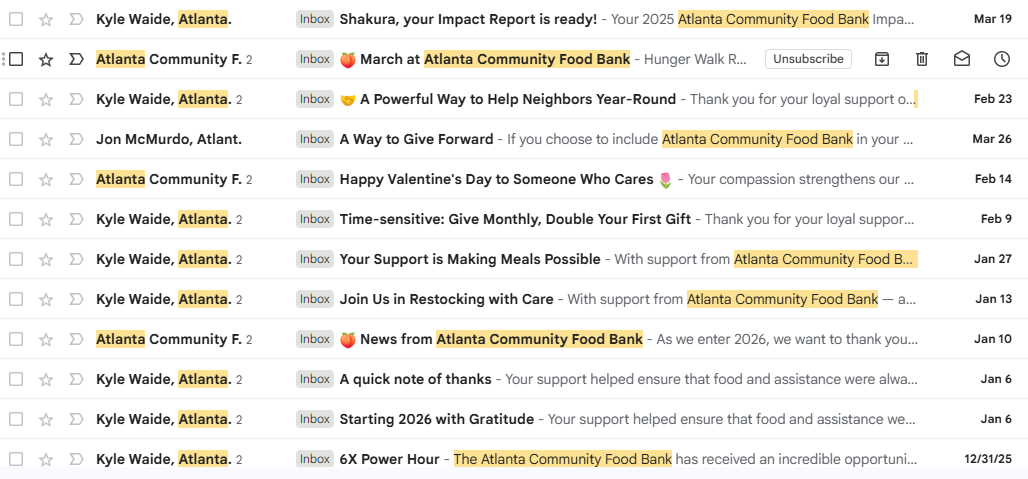
Atlanta Community Food Bank, observed across approximately 100 emails sent between summer 2025 and spring 2026.
Atlanta Community Food Bank, Observed April 2026
Interface: Email
Lens: Invite Participation
Pattern: Repeatable Email Campaign Types
Key Signal
Atlanta Community Food Bank appears to organize most of its email strategy around a few core campaign categories that repeat throughout the year. Instead of sending unrelated messages, the organization builds its communications around a small number of recognizable formats.
Why It Matters
ACFB banks on supporters' desire for consistency. Based on how their email strategy is managed, recognition of familiar rhythms makes subscribers more likely to stay engaged.
Observation
Approximately 60–70 emails sent by Atlanta Community Food Bank between summer 2025 and spring 2026 were reviewed. During that period, the organization appeared to send an average of 1–2 emails per week, with cadence increasing significantly during Hunger Walk Run season and year-end fundraising.
Most of the emails reviewed appear to fall into one of six campaign categories:
Monthly newsletters that provide general updates, volunteer opportunities, program highlights, partner stories, and softer fundraising asks.
Matching gift campaigns that emphasize “2X,” “4X,” or “6X” impact, especially around year-end giving and child hunger campaigns.
Event promotion, particularly around Hunger Walk Run, which receives its own sequence of registration pushes, reminders, and countdown emails.
Gratitude and impact reporting emails that thank supporters, reinforce accomplishments, and show the value of giving.
Planned giving and monthly donor cultivation emails focused on long-term support through recurring gifts or estate planning.
Seasonal and holiday campaigns tied to moments like Valentine’s Day, spring, New Year, and year-end tax deadlines.
Even though the content changes, the underlying structure remains highly familiar. The organization is not creating an entirely new campaign model every month. Instead, it returns to the same categories repeatedly and adapts them to different audiences, seasons, and fundraising priorities.
That repetition extends beyond the campaign types themselves. Similar subject line formulas appear throughout the year. Matching gift language is used repeatedly. Hunger Walk Run emails follow a recognizable sequence. Monthly newsletters are consistently framed in nearly the same way, often using the peach emoji and “Month at Atlanta Community Food Bank” format.
The result is an email strategy built around recognizable rhythms rather than constant novelty.
Why It Matters
Many nonprofit teams put pressure on themselves to constantly create something new. Each campaign is expected to have a different angle, design, message, or emotional hook. Over time, that can make an email strategy harder to sustain internally and harder for supporters to follow externally.
What stands out here is not just that Atlanta Community Food Bank repeats the same campaign types. It is that the organization appears comfortable letting consistency do some of the work. Rather than relying on constant novelty, it seems to trust that supporters benefit from familiar rhythms and recognizable formats.
That approach likely creates efficiencies behind the scenes. Teams can spend less time inventing entirely new campaign structures and more time refining what already works. It may also make the inbox experience easier for supporters to navigate. People learn what a matching gift email feels like, what a Hunger Walk Run sequence looks like, and what kind of information to expect from a monthly roundup.
The result is a strategy that performs more like a cohesive system than a collection of unrelated sends.
Why This Works
A limited number of campaign types can make planning more manageable for internal teams.
Repeating familiar campaign structures helps supporters know what to expect in the inbox.
Seasonal updates, new stories, and different audience focuses keep recurring campaigns from feeling stale.
The same campaign types can be reused year after year with updated urgency, metrics, and examples.
Different campaign categories support different goals, including fundraising, stewardship, volunteerism, and event participation.
The organization balances harder asks with softer relationship-building content, which helps the program feel more varied overall.
Familiar formats likely make it easier for supporters to recognize the purpose of an email quickly.
What I’m Watching
Whether more nonprofits begin to treat their email strategies like a portfolio of repeatable campaign types rather than a collection of unrelated sends, and how that shift might improve consistency, efficiency, supporter recognition, and long-term sustainability.